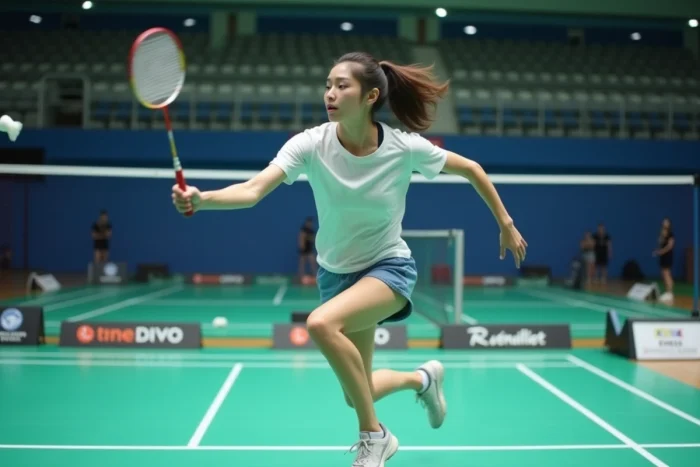
A shuttlecock never bounces, unlike a ping-pong ball. In badminton, the court measures more than double the area used in table tennis, while the speed of play can exceed 400 km/h, far beyond the exchanges of rackets on the table. The changes in direction imposed on players require radically different physical abilities.
International regulations govern the height of the net, the weight of the equipment, and the nature of the surfaces, imposing specific constraints on each discipline. Professional circuits, the average duration of matches, and physical preparation also vary significantly between these two practices.
What really distinguishes racket sports?
Taking a close look at racket sports reveals a range of distinctly different worlds. Badminton, table tennis, squash, padel, pickleball: all share the racket as a common point, but their DNA is entirely different. If we focus on the differences between badminton and table tennis, the entire spectrum of practices unfolds.
Badminton challenges the air: a lightweight shuttlecock slicing through space at over 300 km/h, wide movements, and undeniable physical exertion. The slightest hesitation comes at a cost. In contrast, table tennis imposes a micro-choreography: every move counts, the ball zips, bounces, and spins. Here, instinct, strategy, and finesse make the difference, sometimes down to the millimeter.
The equipment is telling: in badminton, the string is taut to whip the shuttlecock; in table tennis, the paddle and rubber are used to tame the ball. Everything changes, from the net height to the playing volume to the feel in hand. Different disciplines, different codes: padel with its glass walls, squash without a net, pickleball with its perforated ball, each cultivates its uniqueness.
This abundance of styles shows how distinguishing the differences between badminton and table tennis helps to define the identity of each game and guides the curious toward the discipline that suits them best.
Badminton, table tennis, padel, pickleball: rules and courts that change everything
The rules and configuration of the courts shape the character of each racket sport. On the badminton rectangle, measuring 13.40 meters long, the net rises to 1.55 meters. The shuttlecock, almost weightless, travels along elusive trajectories. The pace is frantic: winning the rally means anticipating, exploding, and returning without delay.
Table tennis focuses on a table measuring 2.74 meters by 1.52, divided by a net 15.25 cm high. The ball, light as a feather, bounces on the smooth surface. The game is played in reflexes, precision, and imagination, with each point capable of turning in a fraction of a second.
Padel shakes up the routine: its court, 20 meters by 10, is surrounded by glass walls, and the rebounds become allies or traps. Matches are played in doubles, strategy is built around the walls, and the stringless racket offers unprecedented sensations. With pickleball, the solid racket is paired with a perforated ball. The court size resembles that of badminton, but the game, more accessible and faster, brings together young and old around its conviviality.
Ultimately, whether it’s ping-pong, badminton, padel, or pickleball, a few details are enough to disrupt the practice: a higher net, a lighter ball, a few meters more or less. Each rule shapes the history, postures, and culture of exchange. This is the diversity and richness of these disciplines.
How to choose the sport that suits you? Tips and resources to go further
Between badminton and table tennis, the decision deserves reflection. One must ask what they are looking for: explosive movements, agility, effort management? Badminton engages the whole body, requires quick sprints, sharp coordination, and solid stamina. Table tennis emphasizes quick reflexes, precise movements, and rapid analysis of trajectories just a few centimeters from the net.
Also consider accessibility: table tennis attracts with its moderate cost and the ease with which one can engage, whether in a club or at home. Badminton, also very present in the French associative fabric, requires just a suitable space but remains widely open to the general public.
Here are some benchmarks to situate these two sports:
- Table tennis: an Olympic discipline since 1988, accessible to all, very popular for both leisure and competition.
- Badminton: present in the Olympic Games since 1992, appreciated for the speed of its exchanges and its spectacular dimension, attracting both young people and adults.
To go further, nothing beats reaching out to the federations or clubs in your city. Educational resources, advice from coaches, and testimonials from players will help you better understand the universe of each sport. In France, the diversity of racket sports offers everyone the opportunity to find their playing field, explore new sensations, or experience the spirit of competition in different forms.
Choosing your racket sport is opening a door to a field where every exchange tells a story, where every gesture has its place. It’s up to each person to write their own, racket in hand.