On a a construction site, in a procession, or at the entrance of a festival, you can immediately spot the person wearing a patch sewn on the lapel of their jacket. The message is clear before a word is even spoken. This is exactly what makes the engaged patch so effective: it transforms an ordinary garment into a medium of conviction, without flyers, without banners, without a mobile app.
Freedom of expression on fabric: what French law really allows
Before sewing anything, it’s worth checking a point that many overlook. Wearing an engaged patch in the street is not subject to a neutrality obligation. In France, religious and political neutrality applies to public officials and certain regulated frameworks, not to citizens in public spaces.
In practical terms, a patch expressing a personal opinion does not constitute political advertising in the regulatory sense. We are on the side of freedom of expression, not targeted electoral communication.
The limit concerns the content itself, not the textile medium. A message that falls under insult, defamation, or incitement to hatred remains punishable, whether printed on a patch or written on a sign. It is the text or the visual that poses a problem, not the fact of having sewn it onto a jacket.
This distinction is useful for framing an associative or activist project: one can design a custom PVC patch bearing a campaign slogan, a cause symbol, or a collective logo without falling under specific regulations, as long as it stays within the limits of common law.
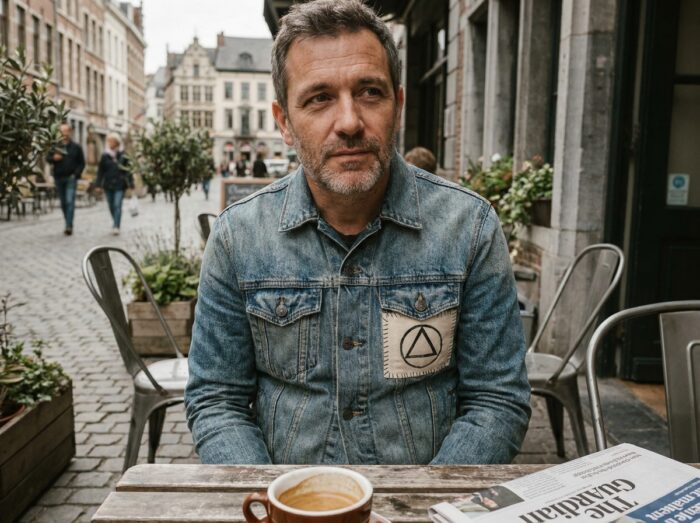
Embroidered, woven, or PVC patch: which medium for which engaged message
The choice of material affects the readability of the message and its durability in the field. You don’t wear an activist patch the same way you wear a decorative badge.
Embroidery: relief and tradition
The embroidered patch adds dimension to the design. The raised threads catch the light, making a logo or symbol visible even from several meters away. However, embroidery limits the level of detail on small formats. Fine text or a gradient of colors will not come out well. For a readable slogan, thick letters on a contrasting background are preferred.
Weaving: finesse and details
The woven patch allows for finer illustrations, with more colors and shades. The finish is flat, almost satin-like. This type is suitable for complex visuals, but it withstands repeated friction less well than an embroidered patch.
PVC: durability and visual impact
PVC withstands rain, mud, and frequent washings without losing its colors. It is the material of choice for patches worn outdoors, on field jackets or protest backpacks. The molded relief allows for sharp cut shapes and strong contrast, ideal for a militant symbol that you want to be recognizable from afar.
- For intensive outdoor use (processions, solidarity works, festivals), PVC remains the most durable.
- For a noble look on a wool jacket or an associative blazer, embroidery adds a valuable texture.
- For a detailed visual with multiple colors (map, illustration, portrait), weaving offers the best definition.
Designing a readable activist patch: colors, size, and message
An engaged patch that goes unnoticed is a failed patch. Graphic design makes all the difference between a patch that stands out and an accessory that is forgotten.
The color contrast determines readability from a distance. Clear text on a dark background, or vice versa. Low-contrast combinations (gray on navy blue, pink on red) make the message unreadable as soon as you move two meters away. Always test the rendering by reducing the image to actual size on screen before approving the mockup.
The standard size for a jacket is about the size of a palm. Smaller, the text becomes indecipherable. Larger, the patch pulls on the fabric and distorts the garment. For an engaged message, you need enough surface area for the slogan or symbol to be understood effortlessly.

The choice between text and symbol depends on the context. A raised fist, a colored ribbon, or a pictogram can be understood from a distance and transcends language barriers. A precise slogan (“Not one more”, “Climate justice”) anchors the cause but requires perfect readability. Combining a strong symbol with two or three words remains the most effective formula for a small-sized patch.
Attachment on jacket: the method that lasts
Thermal patches often come off after a few washes. For a patch that you wear regularly and consider a form of communication, the attachment deserves a bit more attention.
Sewing remains the most reliable method. A few hand stitches are enough on a canvas or denim jacket. Use a thread color that matches the edge of the patch, and stitch through the eyelets or the woven edge. The operation takes about ten minutes.
Thermal bonding works well as a complement: first, fix it with an iron, then secure it with two or three stitches at the corners. This double attachment prevents the patch from coming off during washing.
- On a leather or faux leather jacket, sewing alone is preferable (the iron may damage the material).
- On cotton or polyester, thermal bonding followed by stitches offers the best hold.
- On a backpack or messenger bag, patches with Velcro allow you to change the message according to the context.
Velcro also has a specific advantage for activists who alternate between several causes or events. You can prepare several patches and adapt your message to the situation without having to unpick anything.
A well-designed and well-attached patch transforms any jacket into a silent statement. The garment becomes a durable medium of conviction, visible every day, without relying on social media or an algorithm. Feedback varies on the actual impact in terms of awareness, but one thing remains constant: in a crowd, the eye always stops on the one who wears their ideas on their jacket.