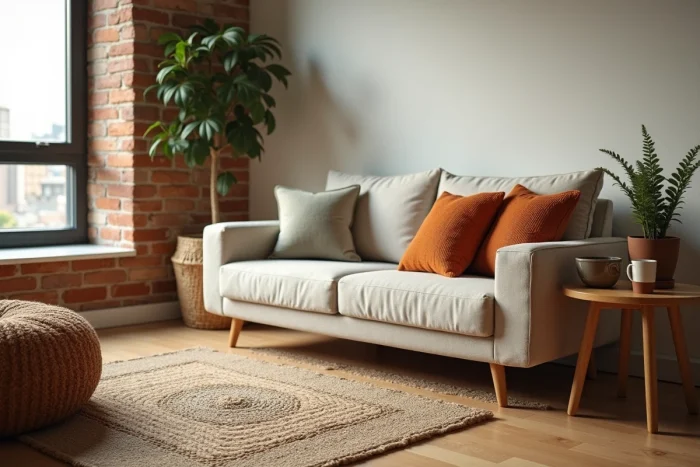
A comfortable sofa is not enough to make a living room inviting. One can pile up cushions and candles without ever achieving that cocoon-like feeling that is sought after. The difference between a warm, modern interior and a simply furnished space often comes down to three or four technical choices, not a long list of decorative gadgets.
Bio-sourced and recycled materials: the underestimated decorative lever
When redesigning a living room or a living space, the classic reflex is to choose between new wood and melamine. This overlooks a category of materials that radically changes the atmosphere: hemp, cork, washed linen, recycled fiber panels, and refurbished wood. These materials provide a visible texture, an irregular grain that breaks the smooth and cold appearance of industrial furniture.
Cork, for example, works well as wall covering as well as under a table. It absorbs sound, feels warm to the touch, and ages without degrading. Washed linen on a sofa or curtains gives a crumpled fall that avoids the showroom effect. The trend reports from the French Furniture Association and the Maison&Objet fair speak of “valorization of circular and tactile materials” in living spaces, and one understands why when handling them.
For those who wish to delve deeper into home decoration and layout choices, you can learn more about Niddou, which gathers resources on the subject.
Thermal comfort and decoration: when a thick curtain replaces a degree of heating
Decoration is often separated from energy performance, as if they were two distinct subjects. However, Ademe emphasizes that layout choices such as thick curtains, dense rugs, and wall hangings contribute to the perceived thermal comfort. A looped wool rug placed on cold tiles changes the perceived temperature of a room without touching the thermostat.
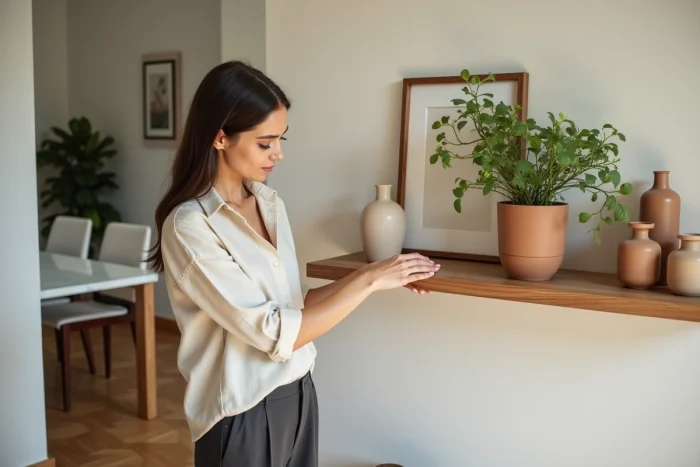
Feedback on this point varies depending on the insulation of the home, but the principle remains the same: the more textile surfaces you multiply in a space, the more you retain ambient heat and reduce the sensation of cold walls. A lined curtain in front of a poorly insulated window makes a real difference in winter.
Specifically, here are the layout elements that play a dual role (decorative and thermal):
- A sufficiently dense rug, made of wool or recycled fibers, placed in the main circulation area of the living room
- Lined or heavy fabric curtains (velvet, thick linen) that reach the floor to limit drafts
- Cushions and throws made of natural materials on the sofa, which warm the seating without adding visual clutter
- A light partition (wooden slats, open bookshelf) that breaks up large volumes and reduces heat loss
Ambient light: multiply low sources rather than relying solely on the ceiling light
The most common trap in a living room is to rely on a single ceiling light to illuminate the entire room. The result: a flat, white light that flattens the contours and gives a clinical appearance to any space.
A cozy interior relies on at least three levels of light: a high source (ceiling light or pendant, at reduced intensity), a medium source (wall sconce, floor lamp), and a low source (table lamp, garland placed on a piece of furniture). It is the layering that creates warmth, not the power.
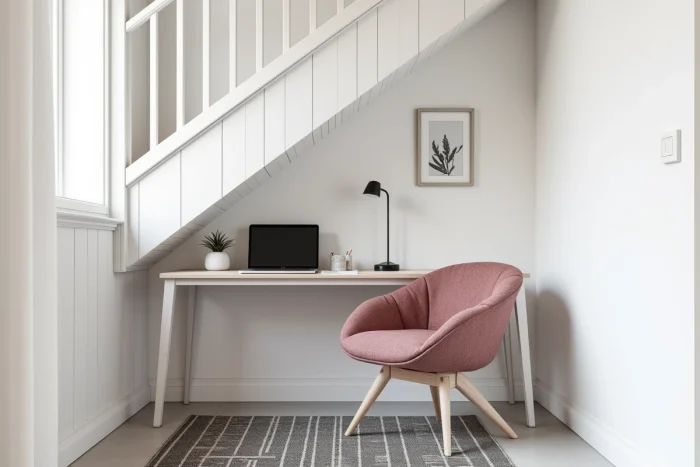
We favor bulbs with a warm color temperature, around 2,700 kelvins. The “neutral white” bulbs sold by default in most supermarkets lean towards the cold and sabotage the cocooning atmosphere. Changing your bulbs costs a few euros and transforms a living room in an evening.
A practical tip: place a table lamp behind the sofa, aimed at the wall. The indirect light reflected by the wall envelops the room instead of casting an aggressive beam.
Colors and furniture: the choices that structure the room
It is often said that neutral and warm colors are necessary. This advice is correct but too vague to be useful. In practice, we think in terms of zones. The main wall of the living room (the one facing the sofa) can support a more pronounced shade: terracotta, sage green, soft ochre. The other walls remain in a light tone to avoid shrinking the space.
For furniture, the question of wood comes up systematically. A light wood piece (natural oak, beech) modernizes the room. A dark wood piece (walnut, wenge) warms it up. Mixing a dominant light wood with an accent of dark wood adds depth without weighing it down.
On the sofa, shape matters as much as color. Rounded lines, with curved armrests, create a welcoming feeling. Straight and angular lines give a more architectural look. The choice depends on the proportion of the room: a small living room benefits from softer shapes, while a large space can afford taut lines.
Regarding plants, we avoid scattering them everywhere. Two or three plants of different sizes grouped in the same corner of the living room create a more striking focal point than a dozen small pots scattered across every available surface.
Creating a warm and modern interior does not require a complete overhaul. A well-chosen rug, repositioned light sources, a repainted wall, and a few natural materials are enough to transform the atmosphere of a living room. The real change comes from precise choices, not accumulation.