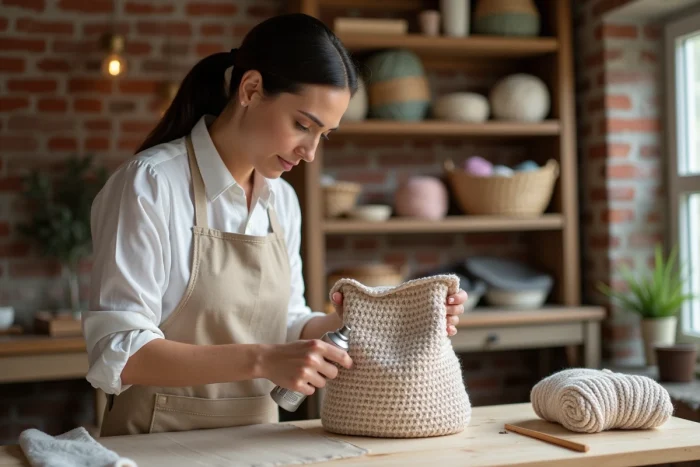
A crochet bag that collapses as soon as you slip a wallet inside poses a structural problem, not a decorative one. Rigidifying a crochet bag means giving it autonomous support, that is to say, the ability to maintain its shape under load without resorting to an object placed at the bottom. Several methods exist, from the choice of yarn to the application of a stiffener, and their effectiveness depends on the type of stitch, the fiber used, and the intended use.
Ribbon yarn and recycled macramé yarn: rigidify from the choice of material
The rigidity of a bag is determined before the first stitch. A yarn that is too soft (fine acrylic, smooth mercerized cotton) produces a fabric that deforms under its own weight. Changing the yarn radically changes the result.
Since 2023-2024, brands like Hoooked, Katia, or DMC offer ribbon yarns made from recycled cotton or polyester designed for bags and baskets. Hoooked indicates, for example, that its RibbonXL and Macramé Recycled Cotton lines are “particularly suitable for baskets and bags requiring good support.” Their flat or tubular section creates a dense fabric that retains its shape without lining or interfacing.
To fully utilize the techniques for rigidifying a crochet bag, the choice of yarn remains the most sustainable lever: a structural yarn often eliminates the need to add reinforcement afterward.
The thickness of the hook also matters. Using a hook half a millimeter smaller than the one recommended on the ball tightens the stitches and limits stretching. A tight tension in single crochet (or half double crochet) produces a fabric that is significantly stiffer than an open stitch in double crochet.
3D blocking on a template: fixing the shape of the crochet bag without chemicals
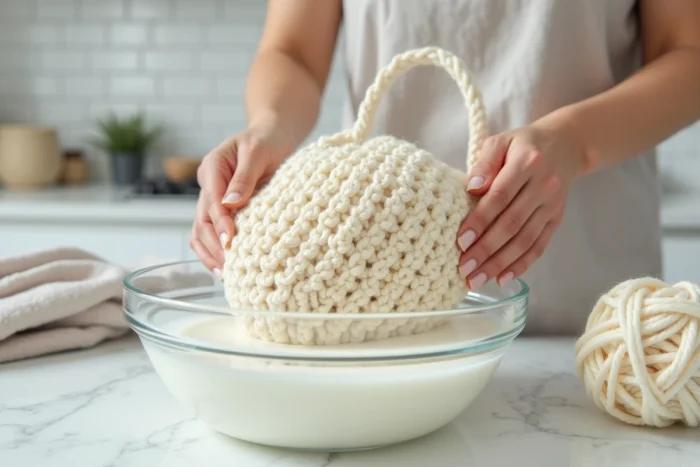
3D blocking is a wet shaping technique borrowed from knitting, adapted for bags. The principle: soak the bag in warm water (or a light stiffener), then let it dry on a rigid block that matches the shape of the finished bag.
The template can be a cardboard box wrapped in plastic wrap, a custom-cut high-density foam block, or even an upside-down plastic container. The fiber, drying under tension on this support, memorizes the shape and gains in rigidity.
When blocking alone is sufficient
On a thick cotton yarn or ribbon yarn worked in tight stitches, 3D blocking can replace any other reinforcement. The result lasts several months of regular use before requiring a new blocking.
When it needs to be combined
On a softer yarn or an open stitch, blocking fixes the initial shape but does not withstand repeated load. In this case, it serves as a complement to a lining or a rigid insert.
Rigid inserts and linings: reinforcing a crochet bag from the inside
When the yarn and blocking are not enough, rigidity comes from within. Two families of reinforcements are distinguished by their function.
- Plastic grids or rigid canvas: cut to the dimensions of the bottom and sometimes the sides, they prevent the bag from collapsing. Available in various sizes, they slip between the crocheted fabric and a textile lining sewn over it.
- Thick felt or faux leather linings: they add mass and support to the walls. Felt (several millimeters thick) also absorbs internal friction that wears out the stitches.
- Thin foam interlayers: placed between the crochet and the lining, they provide a structuring effect while remaining lightweight. Suitable for medium-sized bags where the weight of the reinforcement must remain limited.
The placement of the reinforcement in the right spots determines the result. The bottom of the bag bears the main load: a rigid insert is a priority there. The sides can receive a softer reinforcement (felt, foam) to avoid an overly pronounced “box” effect.
Stiffeners and stiffening solutions for crochet bags
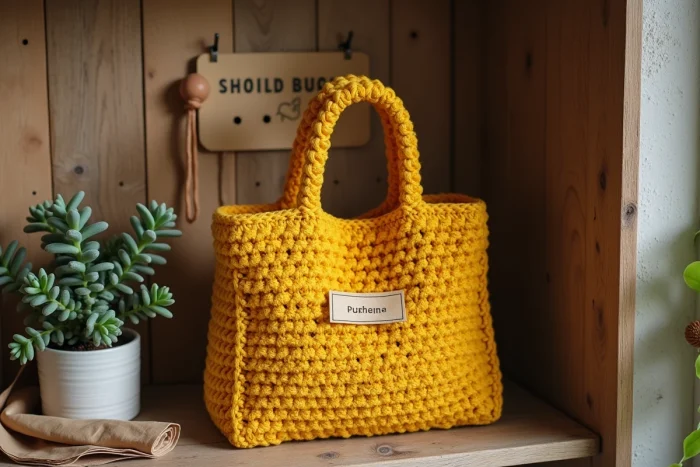
Stiffeners act on the fiber itself by stiffening it after drying. Their durability varies according to the composition and exposure to water.
Starch or textile glue-based stiffeners
Starch spray or diluted textile glue can be sprayed or brushed onto the finished bag. The bag must dry on a template so that the shape is fixed during hardening. Starch offers a natural result, but it dissolves in washing: each water cleaning requires a new application.
Resins and permanent stiffeners
More water-resistant textile resins exist, but they alter the texture of the yarn (more plastic feel, loss of tactile softness). They are suitable for decorative bags or baskets, but less so for bags worn daily against the body.
Regardless of the product chosen, testing on a sample of the same fiber and stitch is essential before applying it to the finished bag. Some stiffeners yellow light fibers or leave white marks on dark yarns.
Crochet stitches and construction: structural rigidity without addition
The choice of stitch directly influences the fabric’s hold. Single crochet produces the densest and stiffest fabric. Half double crochet offers a good compromise between row height and density. Double crochet and treble crochet create a fabric that is too airy to hold its shape alone.
- Continuous spiral single crochet (amigurumi): eliminates row joints and produces a very homogeneous fabric, ideal for bag bottoms
- Crochet garter stitch (alternating single crochet through the front loop and back loop): adds a ribbed texture that reinforces the side wall
- Double thickness crochet (two strands held together): doubles the fabric density without changing the stitch, a simple and effective method for yarns that are too thin
The construction of the bag also plays a role. A flat crocheted bottom that is then raised in rounds creates a pronounced angle that naturally stiffens the base. Adding a few rows of very tight single crochet just at the junction of the bottom and sides creates a structural “fold” that prevents lateral sagging.
The lasting rigidity of a crochet bag rarely relies on a single technique. An appropriate yarn, a tight stitch, and careful blocking form a solid foundation. Inserts and stiffeners come into play as a complement when the fiber alone is not enough or when the pattern requires a more open stitch. Testing each method on a sample before applying it to the complete project remains the most reliable action to avoid unpleasant surprises on a work that takes several hours.