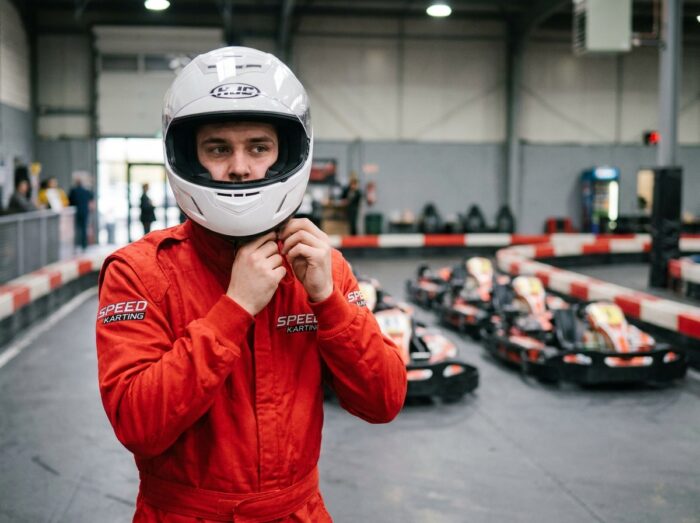
We arrive at the track, grab a helmet from the shelf, put it on, and go for it. This scenario is something most amateur drivers have experienced at least once. The problem is that the few seconds spent checking your helmet before getting into the kart can change the nature of an incident: a harmless slide or an injury to the jaw, neck, or skull.
The helmet provides the majority of protection in karting. However, it is essential to know what to check, in what order, and why some details that we overlook at the moment are just as important as the helmet itself.
Check the standard and the year before putting on the helmet
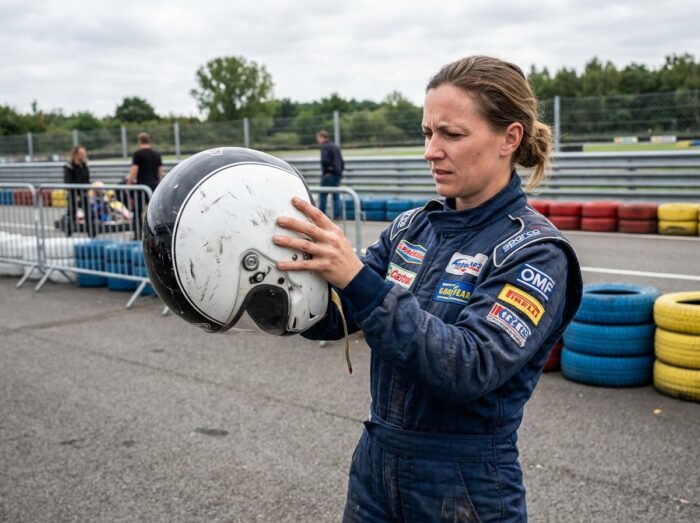
When picking up a helmet (your own or one borrowed from the track), the first reflex is to turn the helmet over and read the inner label. You should look for a standard reference, not just a logo.
Since 2024-2025, a new FIA 8878-2024 standard dedicated to karting helmets has come into effect, alongside the Snell K2025 standard for adults. The generation of the standard has changed: a K2020 certified helmet is not equivalent to a K2025, and some tracks or series no longer accept the old references.
It’s not enough to just spot “FIA” or “Snell” on the label. You need to compare the exact reference (K2020, K2025, CMR2016, 8859, 8878) with the list published by the organizer. If the helmet does not fall into the correct category for its age or series, you do not drive with it.
A karting helmet certified under an expired standard offers mechanical protection, but it also exposes you to being refused on the track on the day of the session.
For those under 15, the requirements are even more precise. Some organizations impose CMR or CMS standards with a weight limit for the helmet set at 1550 g, to protect the necks of young drivers. You should weigh the helmet or check the technical sheet before handing it over to a child.
Fitting the helmet on the head: the steps not to skip
A helmet placed on the head does not protect anything. The helmet should fit snugly without compressing, stay in place when shaking the head side to side, and not pivot forward or backward.
Here are the points to systematically check when putting it on:
- Slide the helmet on straight, without forcing the side padding. If you have to widen the shell to get it on, it’s too small. If the helmet comes down without resistance, it’s too big.
- Shake your head from left to right: the helmet should follow the movement without delay. Any lateral play, even slight, means the shell will rotate during an impact instead of transferring energy to the padding.
- Check that the chin strap (the lower part of the full-face helmet) does not touch the chin at rest. In the event of a frontal impact, this area absorbs the shock. If it already presses against the jaw, absorption will be reduced.
- Pull the helmet up from the back, with the chin strap attached. If it moves more than one centimeter, the strap is too loose.
In rental sessions, you often inherit helmets with inner padding compressed by hundreds of users. If the helmet shifts on your head, ask for another one. No serious track will refuse this exchange.
Chin strap and fastening: the most common weak point
The chin strap is the component most often improperly adjusted. It is buckled too quickly, left loose, or the type of fastening is forgotten.
A properly tightened chin strap allows one finger to pass between the strap and the throat, not two. Below that, it compresses the trachea. Above that, the helmet can be pulled off forward during an impact.
Double D buckle or micrometric buckle
Most competition helmets use a double ring (double D) fastening. This system does not loosen under load, unlike some quick-release buckles. In rentals, helmets are often equipped with micrometric (notched) buckles, which are easier to handle.
Regardless of the system, pull firmly on the strap after fastening. If the buckle slips or the notch pops out, change the helmet. This test takes three seconds and should be done at every session, not just once a season.
Visor and field of vision on the karting track
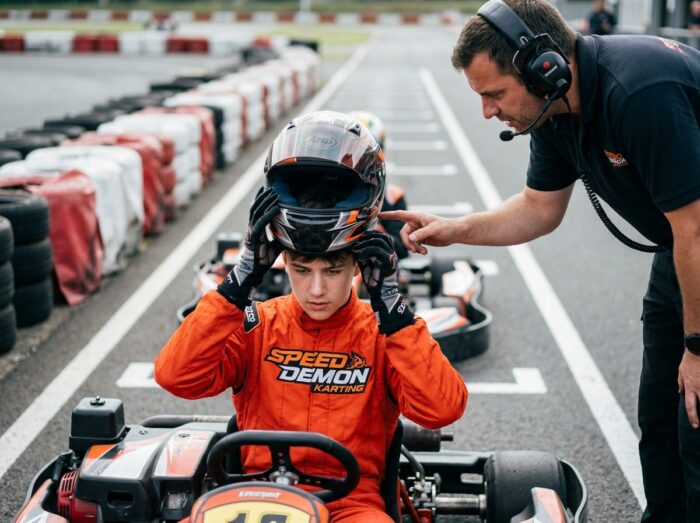
In a kart, you sit very low, looking up to see the track and the turns. A scratched or fogged visor reduces reaction time when braking, especially in indoor sessions where artificial lighting creates reflections.
Before getting into the kart, check that the visor moves up and down smoothly. Clean it with a soft cloth (not the driving glove, which scratches the polycarbonate). If the visor is too damaged to see clearly, replace it or ask for another helmet.
For fog, an anti-fog product applied to the inside of the visor works, but the simplest solution is to slightly open the visor during the warm-up lap. Opinions vary on this point: some drivers prefer an integrated Pinlock, while others find that just cracking it open is sufficient in karting where speeds remain moderate.
Helmet and neck brace: the combination that protects the neck
The helmet alone is not enough to protect the neck. In competition, a neck brace (cervical collar) is mandatory. In rentals, it is rarely provided.
The neck brace limits the head’s movement during a crash or sudden braking. Without a neck brace, the weight of the helmet amplifies the whiplash effect on the cervical spine. The heavier the helmet, the greater the risk, which explains the weight limit imposed for young drivers.
If you have your own neck brace, put it on before the helmet, not after. The neck brace should rest on the shoulders and touch the base of the helmet without lifting it. A gap of more than one centimeter between the two reduces the effectiveness of the protection.
The safety briefing at the track rarely covers all these points. It’s beneficial to integrate them as a personal routine, as automatic as buckling your seatbelt in a car. Three minutes of checking before each session is all it takes to drive with equipment that truly does its job.